
Are you familiar with Search Engine Marketing? No? Well, you should know what is Google, Safari, Yahoo and Bing right? These are examples of Search Engine Marketing!
Have you ever wonder how did the search engine manage to give you what you were looking for, despite having such a huge amount of information online? It was because of Google Search Algorithm! Google Search Algorithm helps us find what we need by sorting through hundreds of billions of web pages in their search index to help users find the most relevant and useful results in a fraction of seconds. Research has shown that as of 2019, Google has accounted for 75.74% of worldwide searches.
What is Search Engine Marketing?

Search Engine Marketing – is one of the effective forms of online marketing to promote and grow the business due to its the extensive geographical reach. The 2 main search engine marketing – Search Engine Optimisation (SEO) and Pay-Per-Click (PPC).

1) Pay-Per-Click (PPC)
Pay-Per-Click, just like its name, it is a paid advertisement. However, businesses have to pay for their marketing only when users clicked on their advertisements. These advertisements are usually the top few searches and as the advertisement that appears above the search results usually gets more clicks.
2) Search Engine Optimisation (SEO)

Search Engine Optimisation is a process where businesses ensure that their page ranks high in the search engine by having the most relevant keywords in the search engine. Unlike PPC, businesses do not have to pay when users click onto their listings, they are also called the organic search.
So, which is better? SEO or PPC?
1. Search Result’s Position and Cost
In Search Engine Optimisation, as the traffic from Search Engine Optimisation is free, businesses will only be able to get the first page top positions if their web page has been optimised. On the other hand, in Pay-Per-Click, although the traffic generated is not free, businesses can get their advertisements on the first page top positions as long as they are willing to pay a high cost per click.
2. Level of Complication
Although I mentioned that Search Engine Optimisation is free and is possible to get the first page top positions, it requires a lot of work and effort to obtain free traffic as the competition is high. Having a high-quality web page is the most important factor in Search Engine Optimisation, hence the only way is to work hard or to hire an expert. Whereas, for Per-Per-Click, businesses only have to pay for clicks their advertisements received. They can also calculate the estimated target to set their daily budget and not have to pay more than what they wanted to.
3. Traffic Potential
If businesses are able to rank their web page in one of the top positions, they can consider Search Engine Optimisation as they will be able to get more traffic with that position. They can also expect to have a continuous flow of traffic without the need to pay for any advertisements. On the other hand, if businesses cannot get the positions on the first page, they should consider Pay-Per-Click as being at the 2nd page onward is difficult to bring traffic. Hence, Pay-Per-Click can help to get more clicks, but at the same time, it also means that businesses have to pay more.
4. Conversion
If businesses are able to focus their target and optimise their marketing, visitors from Pay-Per-Click is more likely to convert. However, a successful Pay-Per-Click campaign can only get clicks from visitors that are interested in the advertisement content. Therefore, Search Engine Optimisation has a better form of traffic but it is not as good as Pay-Per-Click in terms of conversion. Pay-Per-Click has better-optimised keywords hence it will be able to generate more conversion but it will cost more.
Conclusion
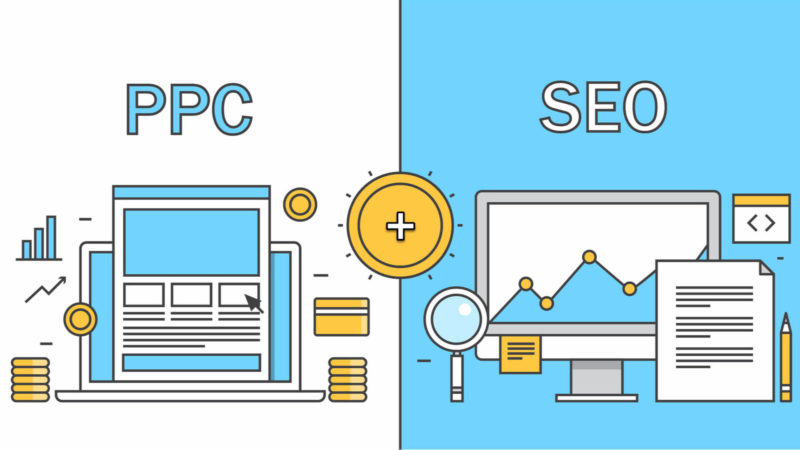
Therefore, comparing traffic and cost for Search Engine Optimisation and Pay-Per-Click, Search Engine Optimisation may be better. Moreover, some research shows that although Pay-Per-Click advertisements are able to get more clicks than Search Engine Optimisation, it also means a higher cost will be incurred. Although Search Engine Optimisation might time some time to develop and optimise, the results tend to be longer-lasting. Whereas, for Pay-Per-Click, the moment you stop paying for advertisements, the traffic will most likely stop.
On the other hand, Pay-Per-Click brings faster results while running a campaign to test which keywords work better. Not just that, Pay-Per-Click has better-optimised keywords hence they are able to generate more conversion.
Instead of choosing between Search Engine Optimisation and Pay-Per-Click, businesses can use both and combine the advantages to accomplish a goal. With both Search Engine Optimisation and Pay-Per-Click part of the internet marketing campaign, businesses can come up with a holistic search engine!
 joyvinawong.home.blog
Hey Joyv, what an unexpected twist, I thought you will choose SEO in the end. I didnt expect you to choose to combine SEO and PPC together. Thanks for letting me know that there’s another way rather than just choosing SEO or PPC.
LikeLike
Hey Yhuix, thank you for the comment!
Hahaha I didn’t know that we can combine them together as well. But now that I see from a bigger picture, I realise SEO and PPC indeed complements one another for better results! PPC can help to bring temporary crowd and SEO can focus on long term!
LikeLike
Hi Joyvina, thank you for sharing your blog with us. It is very informative. Although I agree it is best to use SEO and PPC together. However, there are many other factors that you have to consider as well, e.g. financial. So if you can choose only one which will you choose?
LikeLike
Hi Melody, thank you for the comment!
If I can only choose one between SEO and PPC, I will definitely choose SEO. I am imagining myself as a newly startup company and you have given me a factor to consider with is financial issue. PPC involves is an advertisement which involves cost. I will rather focus on building my webpage and make it to the first page during the keyword search first before investing on advertisements. Imagine if the page is poorly done and I opt for PPC, what is the point of getting traffic? Hope this answers your question! 🙂
LikeLike
Yo Joyv!! What a well thought blog!! Comparing SEO & PPC, I personally think SEO will help to bring more value. After reading your blog, I agree that both SEO and PPC have their own advantages and limitations. I used to side SEO more, I didnt thought of the fact to use SEO & PPC at the same time. 🙂
LikeLike
Yo Elena, thank you for the comment!
Yes, SEO can help to bring value but it is also important to make sure that the webpage is optimised. If it’s not optimised, it will not appear during keyword search and at such situation, PPC will be able to help as it will appear on the first page during the keyword search. I’m glad I managed to convince you that SEO and PPC goes well together! 🙂
LikeLike
Hey Joyvina,
Thank you sharing about PPC and SEO with us. I am thinking of doing a business in the future and from your blog I understand that if my budget does not allow me. SEO is probably the best solution as it does not cost as much as PPC and it has a continuous flow of traffic as long as the webpage is optimised. I’ll keep that in mind, thanks!!
LikeLike
Hey Tan, thank you for the comment!
If you budget doesn’t allow, then the only way to go is SEO. You can focus on optimising your webpage first to make sure your webpage appears during the keyword search. Once your budget allow you can add PPC to see a better result!
LikeLike